
Travel with Young Kids - How?

We’ve learned a lot on our current expedition. In honor of the five years of our oldest kids, here are five “commandments” to chisel onto the itinerary of your vacation (with some fake King James English just for fun).
1. Know Thy Family
For some parents, a 12-hour flight to Japan is a serene voyage with their little angels. The rest of us are picturing an emergency landing in the Pacific to quell the inflight cage match amongst our progeny.
Trips should stretch us as a family - but they shouldn't break us. When it comes to distance and intensity, you know where that breaking point is.

No kids in this Japan picture
The same goes for when you take your trip and for how long. With school and work, use whatever unique levers you have to make as much space as you can. Have young kids? Great - pulling them for a few weeks of kindergarten shouldn’t ruin their chance at Harvard. For work, can you do it remotely? Can you aggressively hoard PTO or take unpaid time off?
What languages do you know? What friendly uncles with far off cabins do you have? Do you like urban or rural? What kind of house setup do you need?
Once you take stock of your family’s unique limitations and advantages, preferences and desires, you should have a trip that’s all your own. Maybe that’s six months in Tokyo - or maybe it’s an AirBnB two towns over. Whatever the case may be, make sure to design your trip with your family in mind.
2. Thou Shalt Travel Slowly
If you desire to travel with young kids, you need to learn to travel slowly.
Your trips are no longer jetting around as fast as you can to see the maximum number of possible things. Slow Travel means living your life in a new place and soaking that place in deeply as a family. In addition to being more rewarding (and often times significantly cheaper with weekly/monthly rates), slow travel is much easier on little people.
Slow travel can be illustrated in the difference between the two trips to Europe that I’ve taken.
Fast Trip 1 (Pre-Kids)
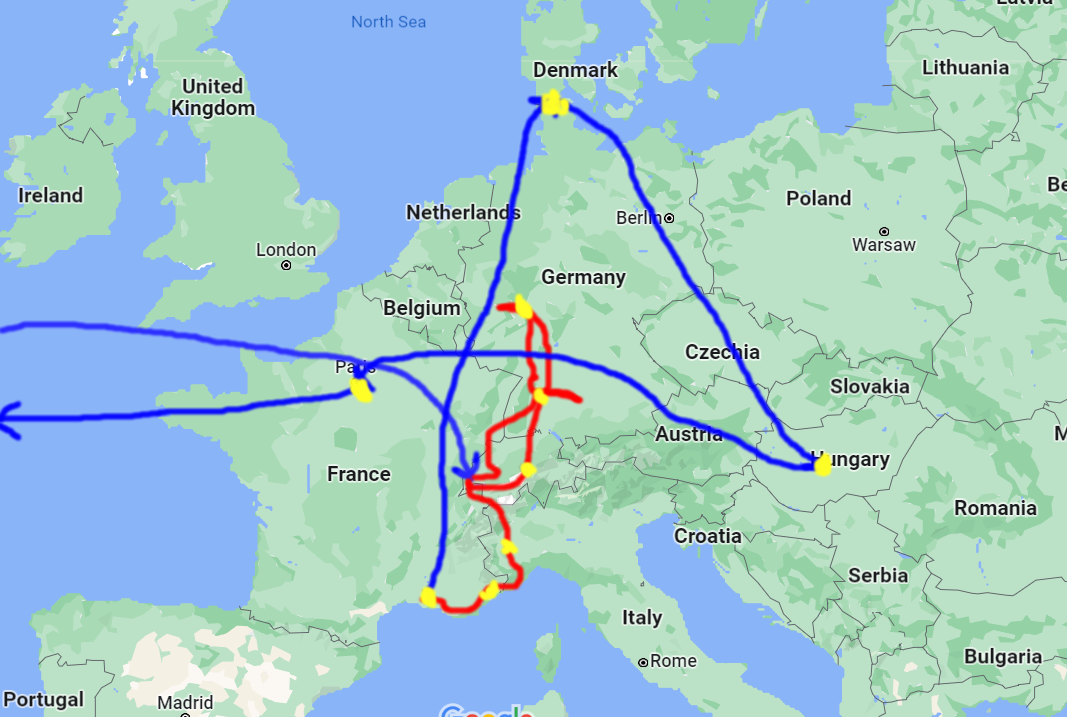
11 different stays across 6 countries. Many flights, much driving.
Sllloooowww Trip 2 (Mucho Kiddo)

2 Stays in 1 Country. Spread over twice as long as trip 1.
The need for bedtimes, play, and massive amounts crap don't disappear when your kids cross an ocean. Instead, these things become more important in a new place. And just think about it for a second - do you really want to be figuring out the pack-and-play, monitor, blackout shades, and nap plans in a different spot every single day?

The biggest gift you can give your kids (and yourselves) is to stay in the same place for at least a week.
For fast-traveling sightseers this is tough (for me too - right now I’m an hour away from Italy- Italy!). But for those who are disciplined enough to limit themselves, a richer experience awaits. For our France trip, that meant that we got to know the ins-and-outs of our city - from the best boulangerie in town to the guys at the local bike shop. By the end, our kids were leading us to all our favorite spots and calling it “Our French Home”. We even made some French friends and hung out with their family on the weekends! (That’s not going to happen when you’re flying around with other tourists to all the “must-see” monuments.)
To be specific, slow travel is:
Day Trips - Check out all the cool spots around your home base
Playgrounds - Prioritize kid happiness and fit the rest (cafes, pubs, museums, etc.) after
Recovery - You can have a crazy day! But then you better take it easy the next day.
3. Pay Not for Thy Flights
You thought that trip was expensive before kids? Try multiplying everything by 5. If flights are involved, I highly recommend you travel for free.
4. Thou Shalt Prep Like a Champion (Today)
If you're currently sitting on the plane wondering if you should have brought snacks and activities for your two-year-old, then let me just say… I'm glad I'm not you.
As soon as we booked the tickets (10 months in advance), my wife immediately got real intense about travel planning.

You ain’t the free-spirit solo-travelers you once were - and you need to up your planning game. So book your Airbnb and start packing.
Personal Soapbox: Hit Pause on Idealism

In "normal times" we try to be as screen-conscious, health-conscious, and every-other-kind-of-conscious as the next family. If there’s a place to bend some of those ideals (so that you can live up to others), it is on a plane, a train, or an automobile.
So for eight hours on the flight, my wife and I gave up our ideals for a “light parental Machiavellianism” - we did anything to get us to that next airport. We brought kiddie tablets. We brought their favorite snacks and treats. We did everything shy of slipping our kids the in-flight whiskey as a sleep-aid. And we made it.
5. Bring Thou Reinforcements
We brought two Grandmas to France and it's made everything from grocery shopping to bedtimes to date nights easier and more fun. Extra hands are the difference between a crazy trip and a crazy trip that approaches (though still rarely reaches) restfulness. Because in reality, there are two options for trips with young kids:
Your Family + Big Trip = Fun, enriching, and exhausting
Your Family + Big Trip + Grandma = Fun, enriching, and less exhausting

Now, if it came right down to it, I’d still travel even if we didn’t have help, but the potential gain is worth trying for. If you don’t have grandparents who are willing and able, all is not lost.
Who in your life might be a good travel buddy? A babysitter? A kid-loving friend? A preschool teacher? (seriously - we have friends who do this) Who would be fun and helpful with little ones? Could you buy (or travel-hack) someone’s tickets and lodging in exchange for a few days of childcare per week? With a little creativity, you might be surprised how doable this is.
Summary
There you have it. Henceforth, thou, thine kin, and thy quest shalt not be vanquished!
Know Your Family. Travel Slowly. Travel for Free. Prep Like a Champion. Bring Reinforcements.
In other words, Gird Thy Loins - and then have fun, you adventurous family.
You can do this!

Travel With Young Kids - Why?
So I guess we’re living in the south of France right now.

A few weeks ago, we bid adieu to the US and chartered a plane to the land of baguettes. After a blur of trains, exhaustion-induced naps, and a fitful night of jet lag, we woke up to soft glow of Provencal sun thawing our frozen Minnesotan bones.
For my wife and I, it’s been a breath of fresh air for our "parent-tired" souls.
Resurrecting Adventure
Personally, it’s been the synthesis of two seemingly-opposing sides of me: Adventurous Brett and Parent Brett.
For Adventurous Brett, the need for big, unique experiences lies somewhere between oxygen and food. But just as I was hitting my stride with world travel in my twenties, I kicked off my thirties by having three kids in two years (Three kids. Two years. … yep).
In the blink of an eye, I transformed from world-traveling-wannabe-real-estate-mogul to housebound-changer-of-diapers. There’s been joy these last five years but let’s just say Adventurous Brett has been on life support.

So despite the real challenges that traveling with little people presents, we decided that now was the time to emerge from the “baby years cave”, peek out through our dark-circled eyes, and see if the world was still there - even though we’ve still got three kids under age six.
For some, a big trip with young kids is obvious (“OF COURSE that's a great idea. We're on our way to Patagonia with two toddlers in tow right now!") For others, particularly parents in the throes of potty training, pre-school, and all the rest, the value may be less obvious.
Isn’t a trip with kids 10x the hassle (and cost) and 1/10th the fun?
I won’t sugarcoat it - this trip is not sipping Rosé on the beach all day while my kids fan me with cool air and appreciation. But as a man who types this sentence with hot espresso in hand and a cool Mediterranean breeze on my face, I can tell you that it's been worth it. Here’s how we thought about it.
Why We Traveled with Kids (Four Reasons)
1. This is the Time!

Two super-Grandmas overlooking the Luberon Valley
In my last post, I made the point that windows of opportunity don’t last forever.
Would it be easier to travel with older kids? Maybe. Sure, flights without tantrums and minute-by-minute-needs would be nice.
On the other hand:
How long until summer basketball and can’t-miss friend birthday parties takes over? (“I don’t WANT to go to Paris! I want to go rollerskating at Jonny’s party!”)
How long will your remote work situation last? How long will credit card companies dole out insane bonuses? How long until the next pandemic/invasion/etc/etc makes your trip impossible?
How many more years will grandparents have the ability and desire to tag along?
The trip you’ve been dreaming of for your family might be easier tomorrow - or it might not.
2. Parent Space
Life is tough. For me, my thirties have been a transition from "innocence to experience".

Hint on our town: It’s where a certain famous painter famously cut off a certain hearing organ…
Whether your life includes a year with reflux-laden twins or just surviving the isolation of a global pandemic, life puts all of us through the grinder at some point.
How do you stay positive and intentional in difficult times? How do you keep your marriage afloat when date nights have been replaced by passing screaming babies back and forth? How do you avoid the learned helplessness that threatens whenever we feel a loss of control in our lives?
A book could be written on the topic of walking well through life’s difficulties (here’s a good one).
For me, a good place to start is simply with space. When we travel we get a chance not to escape our lot in life, but to step back and evaluate what our lives have become- the good, the bad and the ugly.
As I watched the sun rise over the Rhone last week, I remembered back to those difficult early days of being a parent. I reflected on how far we'd come. I asked God what might be next - and I was open to an answer.
How do you get that kind of space to work on and not just in your life?
3. Opportunity to Grow
After 20 hours of trains, planes, and automobiles, my family was exhausted. We had arrived minutes earlier in our destination city’s train station. The last leg should have been a peaceful 20 minute walk along the river to our new home. Only it wasn't peaceful. It was raining. And it wasn't twenty minutes. Turns out with kids (especially tired, wet kids) you need to triple the Google Maps estimate.

To make it with all of our luggage, we needed our boys to not only make the 1-mile walk in the rain but also carry their suitcases while doing it. If this had been a few years ago, my boys would have simply sat down on the sidewalk and cried - and we would have been screwed.
Instead, our hardy little men recognized what we needed them to do, dug deep, and they made the walk. Through soaking rain, through up-all-night-weariness, they did it. I was amazed and I was proud.
On this trip, we’ve all been forced to be flexible, try new things, and even rely on one another. This has been a major life experience for all of us.
And with shared experiences being the glue that bonds people together, what greater gift can you give your family?
4. Beware the Coast
I'm not talking about the Cote D’Azure here.
The first chunk of life is usually where all the action happens. The nature of the school years is one of constant dynamism - a constant barrage of new friends, locations and lessons learned.
Beyond the classroom, things tend to slow down. Whether it’s marriage and kids or just the slow inevitability of age, the vigorous spontaneity of youth often gives way to an unplanned, unspoken "coast" as we float down whatever stream our twenties have brought us to.
But what if it didn’t have to be that way? What if there was a way to stay flexible in the face of monotony? To stay intentional even while more and more of our days give way to obligation? What if we could reverse the shrinking of our idea of “possible” - not just for us, but for our whole family?

Traveling with kids is more than just a few fun pictures next to the Eiffel Tower. Travel jars us loose from the idea that our lives are some passive tram ride (which, let’s be honest- parenting can totally lull you into). A new place is often all that we need to remember that we are active participants on the open road of existence, partnering with God to make a difference in our families and a make dent in this world with the years that we have.
Conclusion
Have I convinced you to consider the crazy idea of traveling, even and especially with those high-maintenance love sponges we call our kids?
I hope so. But even if you are brave enough, I should tell you - there are some essentials you’ll need if you want to avoid mid-flight meltdown or regret in Rejkjavik.
That’s what we'll tackle in our next post.

Are the Big Questions Dead?
“Am I living it right?”
- John Mayer

"My purpose is whatever I make it”, "What does it matter if God is there?" "Haven't we moved beyond these old questions?"
As quickly as these sentiments have seeped into the modern psyche, it's worth noting that “the big questions” about meaning, God, and reality are still, well… big. There’s (still) a lot at stake.
It's not that everyone has always agreed on answers to huge topics like purpose and the existence of God. On these, men and women have come to all kinds of conclusions. But ever since Socrates reminded us that “the unexamined life is not worth living” thoughtful people have joined in common chorus around one big idea: the meaning of your life and nature of reality are worth figuring out.
And yet, most of us live without asking big questions. We go to church or mosque or skip religion altogether without asking “why?”. We believe what our parents asserted or we just drift with whatever our culture is pushing at the time.
It’s tempting to pass topics like meaning and God off as “esoteric”, but the reality is that these questions lie inches below the surface of our daily decisions, experiences, and longings.
Stumbling into Depth
Underneath “What should my major be?” or “Should I have kids?” lie whole root systems of assumptions which can only be probed with deeper questions.
“What is a job for?” “Why should I (or anyone) go through the risk and pain of having kids?”
Now we’re getting somewhere. Brave souls can dig one level deeper.
What is the purpose of my life?
Is there some objective meaning to my life? Or do I make it up myself?
But where would objective meaning come from? There is one candidate…
…Does God exist? What is he like? What might he want from my life?
For some of us, this just got real uncomfortable real fast. Like any good Minnesotan, I too sought to push aside “the big questions” - or at least keep them to myself.
Eventually, my Scandinavian heritage would yield to my inner engineer. In trying to be intentional with my life before I lived it, asking big questions became necessary.
I’m not trying to convince you of an answer. My contention is simply that big questions are not dead. They are worth asking.
Here are a few reasons why.
Ask Big Questions to Clarify Your Purpose

“Begin with the end in mind.” Stephen Covey's second immortal habit is as obvious as it is rare. Covey argues that no project, business, or relationship should be launched without first asking what end are we are trying to achieve, because the steps we take will follow from our purpose.
The same goes for life.
And yet, most of us spend more time planning our vacations than planning our lives. Maybe that’s because to plan our lives, we need to decide what life is - and this can be difficult and scary.
Our present culture tells us that "life is whatever we want it to be". This might be true. Or it might be a accidental byproduct of the "expressive individualism" that rules our tiny, privileged time and place.
To find out we have to ask.
2. Ask Big Questions So You Don’t Miss Out
I’ve noticed a funny theme in my bible reading lately. I’d call it “The Life within life”. It’s all over the book, but let’s just look at a couple passages that become weird when you stop to think about them.
Man shall not live by bread alone, but by every word that comes from the mouth of God.
-Jesus, Matthew 4
Isn't life more than food and clothing?
-Jesus, Matthew 6

Wait, what? We all know people who seem to get by just fine on “bread alone”, without a care for “every word that comes from the mouth of God”. We know people who are very much “alive” with mere “food and clothing” and a full 401k, etc. These are people whose primary concern is their physical needs now and in the future. That’s normal. It’s common. It might be you.
Jesus is saying that you can be alive while at the same time missing out on Life. He’s claiming there is a deeper dimension to what life can be.
Is he right? Or is he full of it?
To find out we have to ask.
3. Ask Big Questions to Understand your Foundations
We all believe in things like free will, morality, and human rights. We can't help it. But for these features of reality to make any sense, we need God.
We’ll all take moral stances in our lifetime, both big ("Putin has no right to invade Ukraine") and small ("She has no right to treat me like this"). We'll assume people matter. We'll act like decisions are real.
Are we standing on solid ground when we do this? Or are we just being illogical robots living in cognitive dissonance?
To find out we’ll have to ask.
4. Ask Big Questions While You Can

Voyager’s iconic picture of Saturn’s rings (750 million miles away)
I just read a fascinating story about the Voyager space mission. The project stemmed from a crucial discovery by Gary Flandro in 1964. Flandro found that Jupiter, Saturn, Uranus, and Neptune align once every 176 years, making a long-range mission possible. Also - the next alignment was in just thirteen years. NASA frantically built Voyager and launched it just in time. Any later and we’d have missed the window.
We want to believe that timing doesn't matter. That life will wait around for us and that we'll always have the opportunity.
The Voyager story teaches us that windows of discovery don’t last forever.
And that's exactly how the Bible talks about life.
The picture that emerges from the ancient book is that now is the time to figure out what life is about (e.g. here, here, here). There are consequences for the answers, both now and later. Is that right? Or a bunch of religious nonsense?
To find out we’ll have to ask.
Conclusion
Friend, I don't know where you're at on this journey. Maybe you've already reached conclusions on the big questions of God and meaning or maybe you're asking them right now. Perhaps you have asked the questions but you’ve drifted away from the answers you know to be true.
Or maybe you've lived your whole life climbing the ladder in front of you without asking if it was the right one.
Big questions can be scary. I can't say where you might end up. But you never know - until you ask.

The Bible in 1000 words (tl;dr)
For those who didn’t catch it in Sunday School…
The same people who tout the virtues of being well-read skip right past the Bible, the most popular book in human history. We’ll binge-read biographies about some hot new tech CEO while skipping the one about the most important figure in Western history: Jesus Christ.

The bible comes out with guns blazing.
Within the first sentence, we are hit with some huge statements:
There is a being called God
By the end of the first chapter, it's clear that in some way, this God made us too. This powerful, worldmaking being has condescended to create partners to rule with him. He makes them like himself and places them in a garden to create, build the world, and have a tight-knit, life-giving relationship with him.
For a while, things are, well… perfect.
Then things go very wrong.
Betrayal
The humans betray God.
Just three chapters in, the whole thing starts to unravel as the first humans are deceived into rejecting God as God, forgoing his ideas about good and evil, making themselves the arbiters of right and wrong. In so doing, they knowingly disobey their maker, their friend, their God.
The humans survive... but something at the core of their being dies. From here on out they will be deeply, irreparably, broken.
These first humans must leave the garden, the fulfilling work, the knowing and being known, the very God-closeness that defined their once-beautiful existence.
Outside the Garden
Outside the garden, life goes on, along with their mission to build the world. Humans continue to bubble over with the goodness given to them at creation. They live and work and make. But there is a darkness that will haunt the human project from here on out.

Outside the garden, work is laced with misery and oppression. Relationships are fraught with brokenness and misunderstanding. People die.
And it quickly becomes clear that whatever this curse is will be passed on.
The first couple’s oldest son kills his younger brother in cold blood. The fratricidal son founds a city... with values that somehow reflect the deep brokenness of its founder.
The next thousand chapters or so document the unfolding - and unraveling - of the ongoing human project. People spread out and expand, technology progresses, culture is made, but at every turn they are dogged by the selfishness and death that the humans can't seem to shake.
Is this world starting to sound familiar?
The Central Question
Here emerges the central question of the bible:
Can what is broken be fixed?
Is there something we can do to mend our broken relationship with God? How do we fix our dying bodies and crooked souls? Can the world be made right?
Human Inability
By the end of the old testament, it's clear that humans will not be able to fix their fundamental problem. Despite God choosing a people (the Jews), giving them deep experiences of his goodness, a perfect set of moral and civil laws for the time, and even land flowing with "milk and honey", it's clear that God's chosen people are just as broken as everyone else.
When the new testament picks up, God's disobedient people have been shattered and scattered and the progress-amidst-brokenness dynamic has reached its apex. The Romans are in charge.
In many ways, the Romans personified the best and worst of what humanity could be. The same people that perfected the republic, gave us Seneca and built still-standing monuments also mastered the art of "might makes right", enslaving conquered enemies and glorifying the torture of crucifixion.
This was when God moved in to fix the problem himself.
The Hero
Jesus was different. Born into Roman-occupied Israel, it was said that he didn't sin like the rest of us. It was said that miracles followed him. It was said that somehow... he was the Son of the Creator God himself.
Jesus loved people regardless of their social status or worthiness. He loved them in spite of their sin.
If there was one group he was critical of - it was the religious establishment.

In apt irony, the confluence of the heights of human power and will - religion and state - conspired and executed the innocent embodiment of love, joy, and life. They killed Jesus.
If the story ended there, we wouldn't be talking about it. But a few days later, the same people who watched him die claimed that they saw him, that he was alive.
They claimed that he was back from the dead and that his death and resurrection had accomplished something.
The Death, The Fix
They claimed that Jesus’ death was the fix that the world had been looking for since the day we left the garden.
That when Jesus died, he had taken on himself our sin and shame, paid the penalty for it, finally bore the wrath that we deserved, and opened up a way to be with God once more.
He had opened a way back to the Garden - back to God himself - and anyone could walk through it.
The way was not a physical path. It was a path for the human soul. One need simply believe and, in a reversal of the first sin, turn from their own ways - lives defined by themselves - back to God.
He said that those who make this move of the soul would gain access into a new way of being, the way of the coming kingdom, even while the world is still broken.
A New World

Finally, Jesus made it clear that while the world itself would stay broken for some time, one day he would return and usher in a new age, an age where somehow everything would be made right. All the brokenness and ugliness would done away with - and the new world, now absent of sin and suffering and oppression would be more beautiful for having been through all the darkness that had come before it.
In Sum
There is a God who made us. We turned away from God and in so doing broke ourselves and the world. Jesus died to take the penalty that sinners deserve, to fix our biggest problem - our alienation from the one who made us. The reason we are still talking about Jesus is that he came back from the dead.
We can be reconciled to God and find a new way of living by opening our life to him and turning away from the sin that has ensnared us since our first parents (trying to be god over our life and world). Jesus will come one last time to remake the world along with those who are reconciled into his life.
That is the story of the bible. And if it’s true, that is good news.
Further Resources
Book: The Drama Of Scripture
Video: For normal, modern readers looking to understand the important (but difficult) book that is the bible, I can’t recommend The Bible Project enough. Here’s their video on this topic: “The Story of the Bible”.

In 1832, Hokusai painted his famous “Thirty-six Views of Mount Fuji”. With each painting, he gave a fuller view of the mountain- and his own perspective. Here’s one of my “36 (or so) views of the world”. It’s an attempt to illuminate an aspect of the present by telling a story of the world through one lens. This essay covers what I think is the ultimate meta-narrative: God’s.

Free Travel FAQ
In my last post, I introduced the concept of using credit card signup bonuses to travel the world for almost nothing. If you're like me in the beginning, you've probably got some questions and concerns. Let's take a look at some common ones.
This sounds scary. Won't this ruin my credit score?
This strategy, used over time, will help your credit score. Mine has been in the 800s for years. The fear around signing up for credit cards comes from not understanding how your credit (or FICO) score is calculated. The factors that go into your score are:

On-time payment history (35%)
% of total credit used (30%)
Length of credit history (15%)
Credit mix (10%)
New credit (10%).
After getting a new card, here’s what happens:
Small dings
Credit pull. (any time you pull your credit there’s a tiny ding). Tiny impact that lasts < 1yr.
New Credit. (because you opened new credit) Minor impact as it’s only 10%. This impact goes away if you cancel card eventually.
Length of Credit History. Minimal impact that becomes negligible if you have an older card that’s been around for a few years. This impact goes away if you cancel card eventually.
Why it goes up
On-time payment history. This is the biggest contributor to your credit score so when you pay on time with a new account you are significantly helping your credit.
% of total credit used. This is the second-biggest contributor to your credit score so when you add new credit, your score goes up (as your utilization % has just gone down).
In the end, your credit should go up. This strategy isn’t much different than what “credit repair” companies do to help their clients increase their credit score.
Who should do this?
People who:
Will for sure pay off their credit cards in full and on time.
All benefits are negated if you end up paying the insane 18% interest or spending more than you otherwise would.
Have a decent credit score
The huge bonuses require an excellent score, but if that’s not you, applying to some smaller cards/bonuses will help you get there.
Can handle some details, are flexible and willing to learn
You’re adding some complexity to your big purchase and your travel. Over time, though, you’ll be able to do it without thinking.
What do I do with the card after I've got the bonus?
You may want to keep using it. For instance, I've kept my IHG card over the years despite the $49 annual fee because they shoot me a free night every year that we use as an excuse for a fancy getaway.
For other cards, you may decide that the long-term benefits aren't worth the recurring annual fee. A good time to close these accounts is 10-12 months after applying for the card.
What if I'm not that into travel?
As much as I love to travel, I get this. After having kids, our appetite for travel all but vanished. The cool thing is that the same habits that get you free travel can also simply net you cash rewards.
Those 100,000 Chase rewards points from last year are also worth $1000 cash. Of course, they could be $2500+ in travel, but if that's where life has you, feel free to take the thousand bucks!
How crazy can I go here? (How many cards can I do at the same time?)
More than you think, but not infinite. The main rule that's come out in the last few years is the Chase 5/24 Rule. Here's the rule:
To be accepted for a Chase card, you can't have opened more than five cards (from any cc company) in the last twenty-four months.
Chase cards are usually the best, so it's good to plan around this (either 2 cards/year or a big splurge and then a long break)
Can I do a card multiple times?
For Amex cards, no (1 bonus per card per lifetime). For Chase cards, yes, after about 4 years. More details here.
Can my spouse sign up for 2x the goodness?
Yes. One great benefit of being married is that all this free travel can be doubled. When you see a good bonus, you can sign your spouse up too for 2x the points.
Do you have any more examples of how you've used this strategy?
I suppose this is where I confess to my exploits to get you fired up enough to try it.
Internationally, I’ve notched free trips to Peru, India, and Europe.

My intense 2015 spreadsheet from our free-flight, mostly-free-hotel, free-rental-car trip to Switzerland, Germany, Italy, France, Denmark, and Hungary
Domestically, I’ve logged free trips to Alaska, New York, Los Angeles (countless times), Milwaukee (countless times - kids under 2 fly free and boy did we know it), San Francisco, Denver, Florida, Charleston, and Minot.
We've used our hotel points and free nights for everything from local getaways to $600 suites in the heart of Paris.
Speaking of free lodging…
I’ve still got to pay for hotels/Airbnbs, though. Is there any way to do those for free?
After booking free flights, many will be content to pay cash for their lodging. For tightwads with remaining gusto, you may wonder: how can I get free lodging too?
There are two ways that I know:
Free Lodging Option 1: Repeat the Process with Hotel Cards
At the time of writing there's an IHG hotels card (think Holiday Inn, Crowne Plaza, and more) that gives you 125,000 points for signup - along with a free night every year. Or there’s a Hilton card that lands you 130,000 Hilton points.
If you are able to meet the spends, this creates a powerful combo of free flights and free hotels.
Free Lodging Option 2: AirBnB Your House while you're gone
By now, most of us have stayed in an AirBnB. Have you ever considered hosting while you're gone? While you're travelling, the reality is that your house is now unused. If you have time to clean it before you go (and move out any sensitive documents, etc), you could have someone pay to stay in your house, offsetting the cost of your own stay.
This option gets interesting as you may be able to net positive income from your trip (i.e. getting paid to travel).
What is the best card for frequent traveling?
For frequent domestic travelers, the holy grail is the Southwest Companion Pass.
At the time of writing: If you get the SW personal card (40k points) and SW business card (80k points) at the same time you will have 120,000 Southwest points. In the process of meeting those spends, you will add another 6,000 points. This gets your total to over 125,000 points in a year which automatically gets you the Southwest Companion Pass for the rest of the year and the following year.
The Southwest companion pass is a reusable BOGO pass for flights. When you have the pass, every flight you book with cash or with your giant point stash nets you another free ticket.
tl;dr: For those who can meet the spends early in the year (January being the best), they essentially have free travel for two years (for two people).
And you can repeat it in two years with your spouse. And then you can do it in four years again…
Isn't travel hacking harder to do nowadays?
Anyone who's been doing this for five years or more could regale you with tales from the "glory days" (ask me about my free month in Europe some time).
This is a game that's always changing and it has gotten marginally more difficult. But if I can still get a family of five to the south of France and back for nearly free in 2022, I'd say it's still a game worth playing.
Where can I learn more
This is just an intro post to an entire world of free travel. For more, check out:
(why are they always guys? What about points girls?!)
How do I parlay my big expense into free travel and help support this blog?
Just use the links on my credit card page. One card signup funds this blog for three months.

You Can Travel for Free
Learn how to play a new game…
This is a brief intermission from the “Faith in the 21st Century” series we’ve been working through. We’ll be back in the deep end soon, but for now, it’s time to travel!

Back in 2012 some friends invited me on an epic trip to Peru. I wanted to go so badly, BUT the $1300 plane ticket (plus everything else) was just too much for my starting salary. With a stack of loans taller than the Andes, I was so sad that I wouldn’t be able to make the trip. Except…
I went anyways.
The key was not “YOLOing” my way into debt, but rather in stumbling upon a strategy that enabled me to be “young, wild, and free” without going broke.
Mystery booth
Before a work flight, I noticed a credit card booth at the airport with a sign that read: "Earn 50,000 bonus miles upon signup". At the time, I ignored it (sounded too scammy).

It was only when faced with my Peru FOMO that I remembered that booth. After a simple search on the airline's website, I learned that 50,000 miles was enough for a round-trip to Cusco, Peru on those exact dates. So… I signed up for the card.
The crazy idea worked. I scaled the Andes, volunteered with a non-profit, and even rode a scooter through the Amazon. I deepened friendships and gained perspective on big decisions (I was married a year after the trip, for one).
Best of all, I did the three week trip to Peru for very little money, with no negative consequences on my finances.
Rinse and Repeat
Emboldened by my South American experience, I repeated the process. Over the last ten years, I've gone everywhere from India to Alaska. In a few months, we’ll be in France.
The thing is… I still haven't bought a plane ticket (with money).
What does this mean for you?
I’m not sure if your hobby is golf, poker, or underwater basket-weaving - but let me share another game with you. This game has rules, details, and strategy too - but it rewards you with free travel for life.
Here’s how you play.
How to Travel For Free
o. Cue: Big Upcoming Purchase
In the free travel game, you get huge miles when you spend a certain amount on a new card (e.g. $2000 in 3 months). Therefore, the process kicks off when you know you’re about to spend a big chunk of money. Rather than putting that new Peloton (or medical bill or whatever) on your standard old 1% back card, you instead get a new card(s) with a juicy signup bonus and put the big purchase on that.
For example, my big purchase last year was finishing my basement. By putting Home Depot purchases (and even my drywaller) on new cards, I realized that I could probably do a pretty big trip.
1.Pick a Destination
When you know you’ve got a purchase coming, you should pick a destination, preferably one that makes your heart beat a little faster :)
For my example, I recognized that with the size of my big purchase I could get ambitious. I asked myself: could I get my whole family to the French Riviera?

2. Create a Card Plan
Now that you’ve identified a purchase and picked a destination, we need to map a “credit card route” to get there.
Figure out your Airline Options
First, we’ll figure out how many “miles” it will take to get to your destination. Just go to a few airline sites, check “book with points”, and write down what you find. For example, here’s a 17,500 mile trip to Los Angeles.

This is Delta. Feel free to check out American, United, or any other airline that goes to your destination.
Card Options
Second, let’s brainstorm some card possibilities to earn those miles (if you’re confused, the next picture should make it clear.) To find the best card bonuses, search Google, check out my credit card page or play with the Mad Fientist’s tool.
You should now have airline options and corresponding credit card options. Now let’s play the matching game.
Here is a real-number example for an LA trip (with a box around the combo I would choose):

Lots of options, but I’d go United - and bring two friends! (50k covers 3 United tix!)
Black-Belt Example: Five to the South of France
For our upcoming France trip, the best airline option was Air France at a steep 300,000 Air France miles.
Thankfully, Chase and American Express were foaming at the mouth for new customers in early 2021 - and their points transfer to Air France. We obtained the needed miles with just three cards.

Me: Chase Sapphire (100k), My wife: Chase Sapphire (100k) and Amex Platinum (125k)

3. Apply, Spend, and Book
Ok, by now you’ve got a purchase, a destination, an airline to get you there, and a credit card (or five) to get you the needed airline points. Congrats! You’ve done the hard work. Now, it’s simply time to execute the plan.
Go ahead and apply for the cards. Don’t be nervous - we'll talk about credit scores and all that in the FAQ. You’ll be accepted on the spot or you can call them if you need to.
When the card arrives, activate it and make your big purchase! (Sign up for autopay too so you don’t forget.)
Once you’ve spent the $, your bonus should show up in your account in a few weeks.
Now go ahead and book your trip with the miles!

Oh yeah, and last step: Go!!!

Conclusion
Travel can be fun, restful, or even life-changing.
In the past, world travel required significant costs, and therefore trade-offs, with other financial goals. Today, that’s different.
Eager credit card companies have made a way for organized middle-class Americans to see the world.
If you are new to free travel, I know you've got questions. Click on the left for some answers. Click on the right to try it out (and support the blog at the same time)!
Where are you headed next?!
or to grab a card…

The Making of Everything
"The first question that should rightly be asked is, "Why is there something rather than nothing?"
-Gottfried Leibniz

Before you read this essay, pause. Breathe. Look at your hand as it touches your computer or phone. Feel your arms and legs. Look around the room to see light as it hits your surroundings.
Your body, your thoughts, you are here on a giant ball we call earth, spinning out into an incomprehensibly large span of cold, heat, light, and matter that makes up the known universe.
Where did all this come from? Why is there anything at all?
You wouldn't be the first to ask. The question was first penned by the Greeks, but my suspicion is that it's been asked by thoughtful people since the dawn of human history.
Let's think about it.
Does the Universe get a Pass?

First, can we assume that everything (including the universe) has some sort of reason or cause for its existence? It seems far more likely than not. Everything in our experience has a cause. We exist and we have parents to thank. The trees in your yard are a result of seeds, water, sunshine and time. Science itself proceeds under the assumption that things are the way they are for a reason - and we can inquire what that reason is. Even those old sparring partners, Ken Ham and Bill Nye, can at least agree there are causes for the things we find in the world and we can know something about those causes.

Universe:
Is the universe itself exempt? Or would something that big, that all-encompassing cry out for a reason even more? The converse - that things exist without reason or cause and we shouldn’t ask why they exist - strikes me as a little absurd… and at least unlivable in the real world.
The universe must have a cause just like anything else - and Plato and Aristotle agree (phew).
This leads to a second question - what would cause a universe to come into being?
Making a Universe
Whatever made the universe is powerful beyond our wildest imagination. The hubble deep field tells us there are roughly 125 billion galaxies - and those are just the ones we can observe. What kind of power could make these?
Second, the cause would have to exist outside of space and time as neither space nor time (by definition) existed before the creation of the universe.

This seems to be consistent with modern physics, which tells us that it wasn't just matter that was created in the beginning but also space, time, and the laws of physics themselves.
In short, if the universe had a cause, the cause would be mind-bendingly powerful, eternal, uncaused, and immaterial (and possibly personal).
So what does all of this mean?
Let’s dust off our thinking muscles and turn those little paragraphs above into premises. Smash them together you’ve got yourself an argument (the cosmological argument to be exact - you philosopher, you).
The Argument
The summary would look something like this:
Everything that exists has a cause
If the universe has a cause, that cause would be powerful beyond imagination, eternal, uncaused, immaterial, (and possibly personal)
The universe exists

The necessary conclusion of this argument is that the cause of the universe is a powerful, eternal, uncaused, immaterial, (and possibly personal) entity. We haven’t “proved” the God of the bible by any means, but we’re getting warmer.
You might like that conclusion or you might not. The conclusion follows from the premises and from my seat, to deny the premises is to land in some weird places (philosophically and practically).
You might have questions - objections, even. To summarize a few objections in a borderline-offensively short way, I’ll just give some quick thoughts on these.
Why does God get a pass on being eternal and uncaused and not the universe?
If you were paying attention, premise 2 (the one about uncaused, eternal, etc.) wasn't put there because we need to exempt God but because that's the sort of cause a finite universe would require.
What about the multiverse?
A few issues with multiverse theory, not the least of which is that we’d now have to explain multiple universes.
What about Quantum Theory?
I love quantum theory, and I hope to dive in someday with the blog. For our purposes here, if you’re banking on quantum fluctuations to create everything from Andromeda to Dr. Seuss, my first question would be where the energy-dense quantum vacuum came from (along with the laws to govern it)?
Conclusion
For me, the cosmological argument has always been persuasive at a gut level. To say that there is no reason for the existence of the universe seems as unlikely as it is unsatisfying.
I wouldn’t call this a “proof”. I don't really believe in proofs, especially for God. To me, it’s just another pointer.
Over the years, thinkers have found ways to try and wiggle out of the conclusion (see Hume for old objections, Krauss for new ones). You'll have to judge if they've been able to do so.
For this armchair philosopher, if it's good enough for Aristotle (and Aquinas and Anselm and Descartes and Leibniz), then just maybe it's good enough for me. Or as Glen Scrivener put it recently:
“Christians believe in the virgin birth of Jesus. Materialists believe in the virgin birth of the cosmos. Choose your miracle.”

History’s Greatest Linchpin
And if Christ has not been raised, our preaching is useless and so is your faith.
-The Bible
The Only Question That Matters

If you want to disprove Christianity, don't go to the age of the earth, evolution, or weird stuff in the bible- go to the resurrection. It's Christianity's self-described linchpin.
But in 2022, how much can we know about something that happened two millenia ago? Turns out, a lot. The resurrection story isn't just unique in what it claims, but also in its early and prolific historic documentation of those claims. No one’s asking you to “just have faith." You’re going to need your brain for this one.
It turns out you don't need to believe the bible is an inspired book to believe in the resurrection. Feel free to treat the bible like any skeptical scholar would treat it - as a historical document with numerous claims of varying reliability.
So which biblical and extra-biblical claims are well-founded historically and relevant to the all-important "back from the dead” question? Here are the cliff-notes, an honorary degree in resurrection studies from Average Joe University. Turns out there are a few basic facts that scholars of various theological (and a-theological) viewpoints agree on.
The Facts
Here are some largely agreed upon facts from New Testament Studies:

1) That Jesus died by crucifixion;
2) That very soon afterwards, his followers had real experiences that they thought were actual appearances of the risen Jesus;
3) That their lives were transformed as a result, even to the point of being willing to die specifically for their faith in the resurrection message;
4) That these things were taught very early, soon after the crucifixion;
- Gary Habermas,“Minimal Facts on the Resurrection”
There’s nothing explicitly supernatural here. Some scholars might disagree with one or two, but they fight an uphill battle in opposing the established consensus view on each one.
The million dollar question, then, is what story best makes sense of these facts?
We don’t need blind faith - we need (our inner) Sherlock Holmes. We need to construct hypotheses, test and eliminate, and choose the best one. Over the years, many have done just that.
Sherlocking the Resurrection
We should prefer natural theories over supernatural ones. So over the centuries, naturalistic reconstructions (accounts without God or the supernatural) have been put forth to account for these facts. They fall into four buckets:

Legend creation: The story was changed / embellished over time.
Mass hallucination: Disciples only thought they saw Jesus back from the dead.
Jesus didn't really die: It just looked like he did. This is actually the Muslim take, FYI
Conspiracy Theory: Disciples stole Jesus’ body and lied about it.
To be “blogpost-level-concise”, these theories all suffer from fatal flaws.
Legend creation: There just wasn't enough time that passed for legends to develop.
Mass Hallucination: While hallucination is very much a thing, mass hallucination is not.
Not really dead: Roman soldiers were experts on human death. Also, crucified people left in a cold dark tomb don't recover without medical help. Here’s a dramatic youtube refutation of this view.
Conspiracy: Grief-stricken, disillusioned groups of fisherman and tax collectors don't come up with paradigm-shifting religious ideas, pull off the greatest conspiracy of all time, and then die for ideas they know are false.
An Inconvenient Truth
"When you have eliminated the impossible, whatever remains, however improbable, must be the truth."
– Sherlock Holmes
Of course, there is a theory that makes perfect sense of these facts, but the theory comes loaded with implications for the universe… and our lives. And we don't always like that.
Most of us would rather suppress the truths that are too uncomfortable to handle, particularly those about God.
The theory that makes sense of the facts is that Jesus died and then came back from the dead.
If that is the case, his life and teaching deserve a closer look.
Conclusion
At the beginning of my search, I thought I needed to figure out if I believed in God first, and then peruse the entire canon of world religions, painstakingly working through Muhammad, Jesus, Buddha, the bible, the problem of evil and suffering, and all the rest.
For me, it ended up working backwards. In zooming in on the resurrection of Jesus, I came to believe that Jesus had really died and had really come back from the dead.
The implications of that one conclusion informed many of the other questions I had. The existence of God, the afterlife, and the truth status of other philosophies and religions all found their answer in who Jesus was - the resurrected Son of God.
The answer gave me some rope to keep believing when I came across difficult things in the Bible or the world that I didn’t like or understand. Most importantly, it made me want to listen to what the guy said.
Of course, this is just my take on the all-important question. We must all answer the question Jesus asked Peter all those years ago.
Who do you say that I am?
Comment
What are your thoughts on the resurrection?
Subscribe
Read More
Popular: Case for Christ (it’s also a movie now, apparently)
Academic (long): The Resurrection of the Son of God

A Shortcut for the Spiritual Search
“Anyone who really wants the truth ends up at Jesus”
-Johnny Cash

Jesus said he’s the way, the truth, and the life. For me, he was the shortcut too.
After my summer of doubt, I was consumed by a question: How do you go about figuring out which religion or philosophy is true when there are so many out there?
It had dawned on me that the menu of religious and philosophical options is less like Chipotle (“black or pinto?”) and more like a Chinese restaurant (“I'll take #17 and my wife will have… #46?”).
Faith options come in endless flavors - eastern and western, new and old, secular and theistic. When forming a worldview, where do you even begin?
Turns out, you should start with Jesus.
I know what you're thinking: "Ok, Mr. Biased Now-Christian. Of course you want us to start there."
Sure, I'm biased towards Christianity for reasons we’ll get to below. But I'm also biased toward efficiency - and if you can make your mind up on Jesus, you narrow your search considerably.
It's like an old game from millenial past…
Playing Guess Who with Jesus

"Does the person have glasses?"
"Yes"
[flips down all but 3 people]
I'm looking at you, in the second row, Joe…
Mathematicians know that in “Guess Who?” better questions lead to faster answers. For spiritual seekers, “deconstructers”, and doubters, the same principle holds true.
In “Worldview Guess Who”, “Who is Jesus?” is the most strategic question you can ask. Why is that?
Jesus the founder of the world’s most popular religion - in looking into him, you’re starting with the most worshiped person in human history.
His claims are unique among major religious figures. Buddha, Muhammad, and Moses never claimed to be God.
You’re killing multiple birds with one stone. Because of his incredible claims, other religions are forced to make a call on who he was, either explicitly (e.g. Islam) or implicitly (e.g. atheism, Judaism). In studying Jesus, you’re actually sifting through multiple major religions at the same time.
Making up your mind on who Jesus is (either way) will clear out a huge chunk of the board.
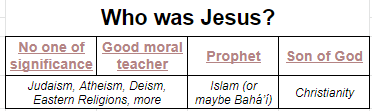

If Jesus is no one of significance, didn't exist, or is just a good moral teacher, you can cross out the worlds' two most popular religions in one go (Islam and Christianity). If he's just a prophet, get out the burka because you, my friend, are now a Muslim. If, however, he is more than that - say, the Son of God, then we’ll need to take a closer look at his life and teachings.
“Ok” you’re saying. “Start with Jesus. But isn't the Jesus question intertwined with other contestable questions like biblical inspiration and if there is even a God to begin with?”
Not for our purposes. While existence and inspiration are big issues, let’s bypass all of that. If we can make a call on if the guy really died and came back from the dead, we’ll have the most important piece of data available. The implications to that answer will tell us a whole host of things about the existence of God and the truth status of the most popular religions in world history.
To summarize, for spiritual seekers:
Jesus is the shortcut
His resurrection is the shortcut to the shortcut.
But surely, I wouldn’t introduce such a big topic in the medium of a blogpost? Oh shoot- turns out I did.
Comment
Who do you say that he is?
Subscribe

We All Believe

Why do some people believe in God while others don't?
The Bible gives a weird answer that I didn’t understand for a long time.
If I were writing the Bible, here are verses I would include:
"Some people are just more inclined to religion than others"
“We're all just doing our best with the evidence in front of us"
But those verses aren’t in the bible.
Here's what is in the bible:
“For the wrath of God is revealed from heaven against all ungodliness and unrighteousness of men, who by their unrighteousness suppress the truth. For what can be known about God is plain to them, because God has shown it to them. For his invisible attributes, namely, his eternal power and divine nature, have been clearly perceived, ever since the creation of the world, in the things that have been made. So they are without excuse.”
-Romans 1:18-20 (my emphasis added)
That is a controversial description of belief in God.
The writer is saying that:
Every human believes in God (v.20)
His existence is plain to anyone who's living in the world (v.19)
Rather than embracing God, humans suppress the knowledge of God (v. 18)
For years, I thought this was silly. Was Paul really saying that Richard Dawkins (or [insert your favorite atheist here]) is really some sort of closet evangelical?
Kind of.
He's saying that God has baked his "invisible attributes" into "the things that have been made" (i.e. us and the world). We don't need to be scholars or philosophers to perceive him- the answers are right there in our everyday lives - in how we live.
Things like free will, good and evil, human rights, logic, beauty, meaning, love, the existence of matter itself. These things aren't the end of a syllogism. They are perceived by professor and plumber alike (v. 20). And those things don’t make sense without God.
We all live like God exists. But because of what acknowledging God might entail, we simply take these features of God’s world - and deny the God who made it. We embrace cognitive dissonance.
So secular conservatives point out government corruption, the importance of free "choice", and the inherent "evil" of totalitarian states. Secular liberals argue that Black Lives "Matter" and fight for abortion "rights" and denounce corporate greed. Even Richard Dawkins can't help going on moral crusades despite his moral-less universe.
Without God, all of this is inconsistent foolishness. It's denial.
Once I understood this Bible passage, I started seeing it all over.
A gay rights rally? Just an odd way of people saying they believe in God (from whom do rights come?).
Someone calling out Donald Trump for his latest scandal? Another profession of faith (from where does morality come?).
Black Lives Matter.
Women's right to choose.
#MeToo
Immigration.
Environment.
God, God, God, and more God.
"But this is just sloppy thinking on the part of non-theists" you might respond. "Surely, the more thoughtful among us can avoid this." Not so. We all live like God exists.
Here's what Romans 1 looks like in high-profile intellectuals who are clearly not fans of God - but live as though He is real as their mothers.
Bertrand Russell on Morality

I have no difficulty in practical moral judgments, which I find I make on a roughly hedonistic basis, but, when it comes to the philosophy of moral judgments, I am impelled in two opposite directions and remain perplexed.
-Bertrand Russell
Possibly the most famous atheist of the 20th century, Russell was famous for his vocal, wide-ranging moral stances on world government, women’s rights, marriage, and war. He also didn't understand how someone could believe in objective morality.
Galen Strawson on Free Will

"[The impossiblity of Free will] can be proved with complete certainty"
...
"I can't really live with this fact from day to day. Can you, really?""
- Freedom and Belief
Albert Camus on Meaning

“There is only one really serious philosophical problem, and that is suicide."
Despite Camus’ academic views on the meaningless of his (and everyone’s) life, he would work tirelessly towards multiple causes throughout his life including the French Resistance in WWII and a wide range of moral issues.
Christopher Hitchens on Human Rights

Christopher Hitchens was a well known atheist (of New Atheist Fame). While he would make a career out of arguing for God’s non-existence (his magnum-opus on the topic being “God is Not Great: How Religion Poisons Everything”), he also would take a number of moral stances throughout his life - including, surprisingly, being against abortion.
We don’t always want to believe in God, we just have to live like he’s there.
Comment
Where do you see cognitive dissonance in the world today? Or in yourself?
Subscribe
Share
Who could benefit from this post?

The Inescapable God

It's hard to live like there's no God - it might be impossible.
Many in the west are dropping God from their worldview. They may or may not realize that they are picking up a new worldview (one without God).
Few that adopt a God-less worldview work out its implications. Fewer still live by those implications.
Most of us (actually all of us as we'll see) believe in things like free will, human rights, morality, justice, and meaning. These things make perfect sense within a Judeo-Christian worldview. Made in the image of God, we are given a purpose, dignity and worth, and a moral sense to comprehend the moral law that permeates the world.
If there is no God, none of those things are real. Free will, morality, human rights, and meaning in life are fictions.
What's wrong with believing that?
Nothing... except real life.
Free Will
There is no free will in a universe without God. We are just biology. Biology arises from chemistry, chemistry arises from physics, and physics tells us that we are simply a bundle of atoms.
Atoms don't choose. Their location and velocity depends on prior location and velocity. There's no "free will variable" in Newton's laws or quantum theory - it’s already determined. In a universe without God, it turns out that we are robots.
But try to live a day denying that you have free will.
Try it in the burrito line at Chipotle. Notice when convincing a friend to watch a TV show or come to a party. Consider when you criticize the president for what he did or didn't do.
You're assuming that you, your friend, and the president have a choice. If it was determined, why argue anything? It's already determined.
My personal favorite is when someone tries to convince someone else that free will is not real (cue Alanis Morissette).
Is this an accurate description of the world and our experience?
In the philosophy room, it's easy to dismiss God. But real life is stubborn. It grabs us by the collar and forces us to believe in things like free will. We can't function without it.
But for free will we need a worldview that includes God. When we make a choice, when we argue or protest someone's actions, we are believing that free will is real.
We live like God exists.
Morality
There is no morality in a universe without God. Matter is all that is... and it just is. Arguments over morality are like arguments over which color is the best - one person's feelings against another's.
But try living a day without morality.
Read about the latest murder. Remember armed jihadists taking over a plane of terrified travelers and crashing it into a skyscraper. Let the reality of millions of little boys and girls on the trains to Auschwitz (and those bringing them there) sink in.
Think too about the social workers, policeman, and teachers working to make our world a better place. Think about the firefighters climbing up World Trade Center stairs, saving lives and giving their own. Think about families across Europe risking their lives to harbor their Jewish neighbors.
Is the firefighters' bravery the same morally as the Jihadists' murder? Are Adolf Hitler and Josef Mengele the same morally as Mother Theresa?
They are in a universe without God.

In a world without God, might is what makes right. Without God, survival of the fittest is our ethic and there's a strong case to be made that the Nazis were performing a moral good.
Is this an accurate description of the world and our experience?
If God exists, there is a transcendent moral code that exists across space and time - and we know it. If God exists, we can condemn slavery or the Holocaust even though those in power believed it was right at the time. If God does not exist, we can't.
When we condemn war, child abuse or genocide, we are saying that morality is real.
We live like God exists.
Human Rights
There are no human rights without God. A person has the same instrinsic value as a puddle of mud. A child is as valuable as a lawn ornament.
But try living a day without believing in human rights.
"Black Lives Matter". "Blue Lives Matter". Without God, the only lawn sign that makes sense is one that says "No Lives Matter".

Gay rights, civil rights, women's rights - all fiction.
What are "rights" in a material universe? When did they come into existence? How do you know they are there? Why should we abide by them?
In a world without God, a society that wanted to get rid of a people group, could simply decide that it brings utility to the rest and get rid of them - without argument. It would be the right thing to do.
Is this an accurate description of the world and our experience?
If there is a God, humans do have rights. Justice is something we are supposed to work for because black lives, blue lives, young, old, democrat, republican, gay straight, Muslim, Buddhist, all have tremendous value. They matter.
So when we condemn slavery and genocide, when we stand up for people's rights, when we protect the vulnerable, we are saying that humans have inherent value and rights (which only make sense if we're made in the image of God).
We live like God exists.
Meaning
Life has no meaning if God does not exist. We will die and so will humanity. Our achievements and our wars, our art, technology, and progress will be forgotten without witness as our sun burns down alongside the wider universe.
But try living a day like life has no meaning.
Why do you get out of bed? Why pour yourselves into work? Or kids? Or a cause?
We can delude ourselves with ideas like "subjective meaning" but subjective meaning is no meaning at all.

Albert Camus, the 20th century authority on meaning without God, summed up his life's work well - “There is only one really serious philosophical question, and that is suicide.”
Without God, nothing matters.
Is this an accurate description of the world and our experience?
With God, everything matters.
Our work, our parenting, our struggle for a better world are all of utmost importance. We are partnering with God on things that will last into eternity for people who will last into eternity. Even our incomplete, imperfect work awaits the day where God will complete what he's started in us.
In 1974, Ernest Becker won a Pulitzer prize for his book "The Denial of Death". Its core thesis: it is impossible for humans - religious or otherwise - to live as if life has no lasting meaning. We simply can't do it.
Does your life matter? My bet is that you live like it does - we can't help it. When we wake up, go to work, raise our kids, fight to make our world a better place we are saying that life has meaning.
We live like God exists.
Conclusion
Few non-theists work out the implications of their worldview. Fewer still have grappled with the incompatibility of those implications with real life.
If our boots have leaks, we need different boots. If our worldview can't account for reality, we need a different worldview.
A worldview without God has no room for fundamental aspects of our lives - and our humanity. Furthermore, it doesn't provide helpful guidance for living a good life. If anything, the opposite is true.
Back in the thick of my doubt, there were days where I was sure that God didn't exist. But I noticed something. Even on the days that I dismissed religion as a silly, inherited set of beliefs, I saw that it didn't really matter what theoretical conclusions I had reached about the existence or non-existence of God. I couldn't escape living as though God was real. It's just part of being human.
We live like God exists.
Comment
Do you live like God exists?
Subscribe
Share
Who could benefit from this post?

Hiking Boots and Worldviews

I was panicking on a cold Alaskan mountain.
My hiking boots had just soaked through. The temperature started to drop.
The realization sank in.
"What have I done?"
Boots
I was Caribou hunting in remote mountains east of Fairbanks. I was ill-equipped.
In planning for the trip, I had considered a few different hiking boots for the rugged Alaska terrain. It was unclear to me which boots were the best, so I chose some old cheap ones.
Big mistake.
On the first day, as we ascended the mountain, it rained. And then it rained some more. I felt my socks dampening. Then they saturated. As we climbed, the temperature cooled to near-freezing.
I would survive (and even get a Caribou), but the mist and showers would continue for the rest of the trip. My boots would never recover. I had to borrow from friends - socks, fire supplies (I ended up melting the boots trying to dry them out :/).
My boots looked good in theory from the comfort of my house. But they weren't ready to handle all that the real world threw at them. It was foolish and dangerous.
Worldview

Choosing a worldview is like choosing a hiking boot for an adventure. You think, you debate, and then you pick. Finally, you step out into the world to see how it works.
Choose well and you'll be ready for anything. Choose poorly and you'll find frustration and misery. You'll need to borrow from someone else.
What’s in a (Good) Worldview?
Oxford defines worldview as "a particular philosophy of life or conception of the world". Some get theirs from religion, philosophy, or their own brain. Many distract themselves so they never have to think about it.
What makes a good worldview? I think back to my own story and what I was looking for.
My searching boiled down to two questions:
What's true?
How do I live? (in light of what's true)
Some worldviews are better than others. Just like boots, some look cool and some are a little funky. For boots and worldviews, we need one that works. We need one that explains the world well and guides our lives.
If it can't do those things, we are in for discomfort and maybe even danger.
Many assume that if we simply walk away from God, then we don't have to worry about belief (or worldview) anymore.
But that's not how worldviews work. You don't abandon. You exchange. We've all got our mountain to climb, and barefoot is a choice (a very leaky one).
You can distract and ignore, but the worldview game is one that we all must play.
In my intro to this series, I mentioned a new worldview on the rise in America: the "nones" - call it atheism or agnosticism, the deconstructed or the deconverted.
In our next post, let’s put this view under the microscope.
Comment
How did you arrive at your own worldview?
Subscribe
Share

How I (almost) Lost my Faith
“I’m convinced that we could divide Christians into three groups. The first would consist of those who have doubted.
The second would be those who haven’t doubted yet but who will. The third group would be those who have completely shut off their brains!”
-Lee Strobel

How could a billion people be wrong?
That was the question that started my doubt.
After my life-changing sophomore semester, I left on my first overseas trip: a three-week study abroad program to China. The journey would expand my view of the world- and nearly shatter my simple Christian faith.
China
While touring this strange land, a few questions started to bubble up.
How much did I really understand the world?

What was this place? Why were the people (and their crazy government) so different? What do they believe about God and life?
After the drama of last semester, I thought I had finally figured out the world. But here I was walking through the biggest, oldest civilization on the planet and I knew nothing about its history or people.
Maybe there was more to life than what I knew.
If Christianity is Right, Other Religions (and People) are Wrong
I’d seen pictures of temples in Asia, but what were they but architecturally interesting houses with funny statues?
Something changed when I was in Beijing.
I remember watching an older lady walking up to thousand-year-old Buddha statue, incense in hand. Bowing. Praying.
It was just one lady. But it wasn't just one lady. To me, she represented the hundreds of millions of real people, past and present-, mothers, fathers, sisters and brothers who believed completely differently than me.
In becoming a Christian, was I saying this woman (and millions like her) were wrong?
What happened to the people that are wrong?

There are serious consequences in the bible for people who reject Jesus. Growing up in a “Christian land”, though, I didn’t really have to worry about it.
What a wake-up call to get off the plane to one billion souls who did not believe in Jesus, many of whom hadn’t even heard about him.
What would happen to them?
How did I know that any of this Christian stuff was true?
If you noticed, nowhere in my “spiritual voyage” of the last semester did I question whether Christianity was objectively true.
The “battle” of my previous semester was a battle of the will. My study-abroad created something new - a battle of the mind.
The questions started gushing out:
Why do I trust this book called the bible?
Was I interpreting my spiritual experience correctly?
What about the Buddhism, Taoism, and Confucianism I had seen (not to mention Islam, Mormonism and all the rest).
What did my new faith say about all these people?
The summer ahead would only water the seeds of confusion.
A World of Ideas

Back in the US, my internship left me alone for the summer in a small town, hours from everyone I knew. I was determined to use the summer to make sense of what was true about life and God.
Here was my plan for the summer:
June: Study World Religions
July: Study Philosophy (history, and current options)
August: Come to a conclusion
Surely three months would be plenty of time to understand the history of human thought and leave me with a clear, satisfying conclusion.

Well, I tried.
From "The Idiot's Guide to World Religions" to selections from the Q'uran and the Bhagavad Gita, then Plato and Bertrand Russell to countless Wikipedia bunny trails, I soaked up books and articles like a sponge.
Unfortunately, the more I looked, the more confused I became. It was like I was searching for a pearl of truth at the bottom of a muddy pond. The more I frantically searched, the muddier the water became.
The Agony of Doubt
This was the first time I had really thought about what life was and what eternity might entail. It was the first time I had stared down the barrel of meaninglessness or felt the weight of an idea like eternal suffering. I felt alone on the journey. It was miserable.
By the end of the summer, I was wondering things like, “How do you pray when you don't think anyone’s listening?” “How do I move forward with my life when so many fundamental questions are still unsettled?”
Coming back to school wasn’t much help, at least right away. I needed community, but I also needed answers - answers to questions that no one around me was asking.
The Slow Ascent
One of the hardest things about this life is that the most important topics are oftentimes the least clear. Out here in the wild landscape of deep truth there is no proof, only pointers. Faith will always be required (no matter what you believe).
Eventually, I made it back to committed faith.
My journey would take me through Descartes and Darwin, Calvin and Camus. It would require more time, effort, and intellectual discomfort than I could have dreamed when I set out during that lonely summer of 2007. But I have no doubt that the journey has left me with stronger faith, clearer thinking, and more compassion for people who haven’t figured it all out.
Let me share some things I’ve found along the way.
Comment
Have you ever had a period of doubting? How did you get through it?
Subscribe
Share
Who could benefit from this post?

What Happened When I Became a Christian
I will give you a new heart and put a new spirit within you; and I will remove the heart of stone… and give you a heart of flesh.
-God (Ez.36)

Every day in the northeast corner of Lake Erie, there are fish whose lives are changed forever.
The fish live their entire life in the cool, calm depths of the great lake.
Then one day things change. They find a new spot with a new sensation: current. Something is happening to them.
While some swim back to familiar waters, others forge ahead. Before they can get used to this new normal, there's a noise.
A distant rumble. Then a sudden roar.
Then they are hurtling through the air, unable to breathe, gills pinned to guts as they brace for impact.
They've just plunged 180’ down Niagara Falls. They're in an entirely new place and will never return.
That's kind of what my faith story was like - chance encounters, a new current, a dramatic plunge… and then a new life.
I looked the same. I lived in the same room and took the same classes. But over the weeks that followed, friends would ask what had happened to me.
This post is the answer to that question - it’s what I found downstream.
Spiritually
Bible: Worst to first
Before I walked home from the fateful dinner, I agreed to go with a friend to a church service the next day. It was one of my first times attending a Sunday service in college.
The sermon topic was marriage, a topic that I cared approximately zero about at age 19. But as the pastor began, I was riveted. This was the best sermon spoken message I'd ever heard. The bible was alive for the first time.
And that insufferable weekly study that had made me so miserable for all of first semester? Starting that week, the study became the best, most anticipated event on my calendar.
First semester, the bible had somehow inspired boredom and guilt at the same time. Now I was addicted.
To Be Good

There's a paradox at the heart of the gospel. When you become a Christian, all your sin is forgiven - past, present, and future. This raises an important question: then why be good at all?
I had sensed and lived that tension for the last year and a half. In the blink of an eye, the tension was gone. I wanted to be good.
There was no “shoulding” ("well I'm a full-blown Christian now so I should shape up"). While my sin was still there, alongside it was a new desire - not to numb my conscience like before, but rather to live a holy life, powered not by moral fortitude but by God living in me.
So I changed spiritually - big surprise. But the changes didn't end there.
Intellectually
The "heady" Brett that my friends know was born at this time.
Confession: up until this point, I had been a bit of a closet "romantic". I was smart enough in some ways, but when it came down to it, life was about following your heart and embracing wherever your path (and feelings) took you.

The first book I picked up flew in the face of all of that. It was a pragmatic book on a topic that I didn't think pragmatism applied to. The book was called “Boundaries in Dating" and its central message was that while your emotions are good, they can blind you to reality if you let them.
If you knew how my mind worked up until that point, it was crazy that I read that book. It was even crazier that I listened to it.
Thus began a seismic shift, not just in my dating views, but how I approached life in general. The game had changed. Things didn’t need to “feel right” - they needed to make sense. Life wasn’t just about “fun and feeling good”, it was something to be understood - the books, conversations, and classes that could get me there became the priority.
The only changes bigger than those happening in my head were the ones happening in my heart.
Emotionally
There was a lot going on inside during these years. Anxiety and occasional depression were tips of the iceberg that was my emotional life. Being a good Minnesotan I had learned that if I could just ignore those things long enough, I might be able to get through my whole life without ever having to deal with them.
I quickly realized that if I was to walk this untrodden path of becoming a better version of myself, I was going to need to learn some new, terrifying skills: vulnerability and introspection.
After spurning the advances of my bible study in first semester, I still remember sitting down at Potbelly's sandwiches, of my own volition, and asking my friend if he wanted to meet up for weekly prayer and accountability.
We added another close friend and started meeting weekly. I didn't know it at the time, but this group would become the greenhouse where the seeds of a new life could grow. We laughed shot the breeze, we confessed sin, we let our guard down and we pushed each other.
For me, this group wasn't a new weekly activity, it was a new plane of existence - one where the deepest parts of ourselves didn't have to live alone, unknown in darkness. Light could come in.
Vulnerability was just the start. Over the next two years, through classes, books, conversations and programs, I'd learn about critical concepts like attachment, family of origin issues, neurochemistry and the incredible power of self-talk (CBT). This journey would not be quick, but the seeds that were planted during those weeks in November would set things in motion that would leave me anxiety and depression-free within about three years.
Into the Summer
That semester was the most transformative time of my life. A simple decision led to a fairly dramatic spiritual experience, setting off massive changes to the deepest parts of my life. The drama and intensity of those first weeks and months would eventually wear out, but the new direction would continue.
At the end of the school year, I sailed off into the sunset and life was puppies and rainbows from then on.

Yeah, that didn't happen. That summer would take me far from my safe haven of Christian community, first to a country with state-sponsored atheism before coming home to the most isolating, lonely months of my life.
What I didn't know was that in four months, my faith would be on the brink of disappearing.
Comment
If you’re a Christian reading this - what was your faith story like? Quick and dramatic? Slow and “boring”?
Drop a thought below!
Subscribe
Share
Who could benefit from this post?

How I Became A Christian
The Prodigal Son at least walked home on his own feet. But who can duly adore that Love which will open the high gates to a prodigal who is brought in kicking, struggling, resentful, and darting his eyes in every direction for a chance of escape?
-C.S. Lewis

Should I hide?
I could hear him coming down the hallway, getting closer. I knew what he was after.
Could I squeeze into my closet? Or under the desk? Too late.
"Hey man, bible study's about to start - come on out!"
Shoot.
It was my freshman year of college. I had hoped to distance myself from “the religious thing”. I was failing.
It's not that I had a bad experience with faith growing up. I'm thankful for my Lutheran roots - hotdish, ham buns and all. I had gone to Sunday school, been confirmed, and even played in a youth group worship band.
But college was here. It was time for freedom.
Freshman Year: The Freedom
The only snag was that my freshman dorm hall advisor was starting a bible study for anyone who was interested.
I was not. But he wore me down. Over the first few months of school, his enthusiasm and persistence won out and I checked out the bible study.
When my next door neighbor joined up (and subsequently swung by my room every Wednesday to pick me up), it appeared there was no way out. I was as flaky as I could manage to be, but somehow I managed to keep attending through my freshman year.

Oh yeah, one more thing about my freshman year - I was partying.
Not like a rockstar. More like an idiot kid who had never had alcohol trying to figure out why droves of 18 year olds were jamming themselves into nasty frat house basements, drinking piss-tasting beer and then standing around like they knew what they were doing.
It wasn’t a word yet, but my FOMO was running the show.
So that was freshman year. Wednesday nights were bible study with my Christian friends. Friday nights I was doing shots with the marching band.
I didn't feel like a hypocrite. Cultural Christianity was still a thing at this time in the US and so for every truly practicing Christian I knew up to that point, I probably knew three (or more?) nominal Christians. These were nice folks who popped into church on the occasional Sunday and then just did whatever they wanted with the rest of their lives. Their faith didn't dramatically change how they thought or felt or lived. Maybe I could just be like that.
So everything was great - until sophomore year.
Sophomore Year: The Tension
When I came back for my second year, the seams holding my double life together began to fray.
My “party life” had started to solidify with friends and routines that ensured I could find a beer pong game every Friday and Saturday night. I had even started dating girls from these circles. I was getting in deeper.
At the same time, my "religious life” was pulling me in its own direction. The light, topical bible study material of freshman year had been replaced with deeper, more challenging content. We were talking about topics like the "Lordship of Christ". Basically I was learning that Jesus isn't a spoke on the wheel of a Christian’s life - he is to be the “hub” around which everything else turns. That didn’t sound like freedom to me and it certainly didn’t sound like fun.
We learned about fighting sin in our lives. Most of all, I was starting to understand the gospel message - about who Jesus was, why his death was so important and what it called us to.
Worse yet, I started to meet people - lots of people - who were really committed to Jesus. Their lives did revolve around him. While their joy, peace, and vibrant community were attractive, c'mon- these were the weird "way too into it" religious folks. Who wants to end up like that?
Things came to a head about halfway through the year.
The Breaking Point
I had grown increasingly uncomfortable with bible study. Between the girl I was dating and the alcohol and partying that my weekend life was centered around, I knew these things were what these Christians called sin.

As we sat in bible study, talking about the seriousness of sin and our need to fight it, I felt about as comfortable as a pregnant nun at mass. Each week, I’d count the minutes until the study was over. Always I felt awkward. Sometimes the inner dissonance was so bad I'd almost feel sick.
I told the guy leading it that I wanted out.
He was surprised but accepted my request. His only ask was that I stick around until the end of the semester.
Those next two months would change my life forever.
Everything went wrong. My study abroad plans for second semester fell through. My engineering classes got extremely hard and started to seem pointless. I wondered if I was in the right major (though I was almost halfway through college).
Then came the anxiety. I remember sitting in a study room one night, heart pounding out of my chest in full fight-or-flight panic attack mode. I had no idea what was going on, no one to talk to, and no words to explain it even if I did.
The unfortunate events of first semester culminated when the girl I was seeing broke up with me. I thought it was going to break me.
The weird thing was that it didn't.
The Surprise
Two weeks before the breakup, the wider Christian campus group kicked off a seemingly arbitrary challenge to spend extended time "with God". For whatever reason, I decided that this would be the first non-bible study activity that I’d go along with. The structure was open-ended, so I decided to just read a few bible verses and then sit quietly “listening for God” for about half an hour.
Nothing magical happened. But by the end of the two weeks, I was starting to feel a sense of peace and an increasing sense that God was walking with me through my day.
Then I got dumped.
I felt like existential barf.
The next day, as I descended into the abyss of self-pity, my Christian friends interrupted me. Wasn't I going to the Valentine's dinner that night?
Well, that sounded about as fun as a sledgehammer to the kneecap.
Whether it was the fear of being by myself at such a low point or the promise of a free dinner, they somehow pulled me from "not a chance" to "fine, I'll go".
The dinner was unremarkable. The guys served the girls a big dinner and there was a dance at the end.
What was remarkable was that somewhere in the process of bussing tables and forcing myself to dance like an idiot, all the heaviness of my life lifted. I felt light.
I had thought my life was unraveling- this didn’t make sense. It felt like something was happening to me.
Surrender

On the walk home, I ran it all through in my head. My wrong major. My study abroad that wasn't. My failed relationship. The anxiety and all the dissonant tension of my double life.
This is where my best thinking had got me.
Then the question. Whether it was Someone putting the thought in my mind or just my subconscious bubbling up what was needed, I don't know. But there it was.
"Do you surrender?"
It's the question I had been confronted with all year, the question I had said "no" to, consciously, many times.
This time, though, I was seeing things differently. I had no idea what God wanted to do with me. But maybe he had something better than this life that I had conjured on my own.
A simple midnight prayer on University Avenue. "Alright God, my life is yours." I went back to my dorm and slept.
Then everything changed.
Comment
Drop a thought below!
Subscribe
Share
Who might benefit from this post?

Intro: Faith In the 21st Century

I hadn’t met him yet. Now he was gone.
Three months ago, our property manager found a tenant for our rental property. He was a 21-year-old musician and athlete applying for my apartment while he figured out his next steps in life.
Before moving in, he wanted to do one more trip up north with a friend. This decision would prove to be tragic.
An unexpected windstorm, a poorly equipped canoe, and a series of unfortunate events later and the young man had died.
We cancelled the lease. As we put the deposit check into the mail, I thought of the boy’s mom on the other side of the address. A woman about to bury her own son.
The sadness came. And then the question.
What did his life mean? What do any of our lives mean?
We plan, we dream, we assume eighty years or so, but each one of us lives on the edge of eternity.
What's the purpose of it all?
I first asked this question in college.
My College Struggle

There’s not a reason young adults question their beliefs in college - there’s many. There’s the agnostic kid across the hallway (who’s a better person than you). There’s the classes that seem to explain all mysteries of the universe but don’t seem to mention the God in charge of it all.
More than anything it’s the unique choices set before students every day - and what lay behind them.
For me, daily decisions were the tips of massive icebergs, each with their own set of assumptions about life and the world.
For instance, I could probably get drunk and hook up with someone at a party. But could I safely assume Christianity isn't true, its sexual ethics don't apply, and there's no consequences in this life or the next?
Or I could go to a faith meeting and sing songs of worship and praise to God. But what an insane thing to do if we're just advanced apes trying to survive and reproduce in a cold, indifferent universe.
Everything - friends, hobbies, career choices and calendar were ready to fall into line depending on what I believed to be true. I might be confused as hell (which I was), but the dividing lines between opposing lifestyles will never be more clear.
Behind everyday options are deep questions that deserve years of careful thought. In college, though, this is Thursday night. Your choice.
For me, college was an incredible, formative, and agonizing time. Underneath my education and social life, a war was quietly raging;. The war was between competing worldviews and I was the battlefield. My simple Lutheran upbringing came into conflict with my secular surroundings. Only one ideology would be going home alive.
Fast forward to today, and I’m on the fast track towards being an old guy. The deep internal struggle has slowly been replaced by a tentative confidence as I’ve read, studied and prayed my way through the last fifteen years.
For many Americans, though, the battle for what to believe is reaching a fever pitch.
The American Struggle
We are at a turning point in America.

The cultural tailwind that Christianity has enjoyed since the birth of our nation has become a formidable headwind almost overnight. In the last twenty years, the number of practicing Christians has been cut in half (1 in 2 has become 1 in 4), while the "nones" (atheists, agnostics with no religious belief ) have doubled.
These are massive changes. More incredible than the scale of the changes is the speed at which they’ve come. This isn’t a slow generational change. Baby boomers and Gen-Z alike are quietly walking away from the faith that has held sway in the western world for the last two millenia.
We are witnessing a majority of Americans quietly remaking the deepest parts of themselves.
What is behind these shifts? Where will they lead us? How do we think through these big questions?
Where we’re Going
First, a confession: the posts on this blog so far have been a bit of a warm-up.
I really do love bikes and index funds. But finances and transportation are just window dressings on a worldview. It's time to start laying the foundation - what is life all about? What's the point?
Over the next few posts, I want to dig into the topic that I’ve been thinking about for the last fifteen years: Faith in the 21st century
Does God Exist?
Is Faith important?
Why should I believe?
What does faith look like in the digital age?
Why is society shifting so much and so fast?
What about [insert objection here]?

I'm not a pastor or a priest. I’m not a paragon of moral virtue or a brilliant philosopher. All I have is my own story, the perspective of a guy who’s descended into the shadowy valley of doubt only to re-emerge on mountaintop of faith.
Over the years, I’ve dizzied myself with confusion and trembled as the foundations below my feet felt ready to open up and swallow me whole.
The hope of heaven, the fear of hell, the dread of eternal nothingness are not strangers.
And yet, somehow, I've come out on the other side.
I don't know if my words can help navigate the fog of life's deepest questions. But if they can, I'm willing to share what light I've found.
Let's go.
Comment
Where do you find yourself in our quickly changing culture in regards to faith?
Drop the brief version below!
Subscribe
Share
Who could benefit from this post?

Investing Follow-up: FAQs

The content of my investing post is far from original. If you know about index funds, this is old news. My hope is that through that article a few readers came away with a better understanding of investing (and index funds). If that’s true, you’ve probably got some questions.
1 or 2% fee - what's the big deal?
1% sounds small. But in the world of investing, the results are MASSIVE - particularly over time.
For instance, just a 1% fee on a 10,000/year investment over 40 years would lose $600,000 in value. You read that right.
If you're paying a one percent fee you are making a half-million dollar donation to the richest people on the planet.
In a world where fund managers don't matter, the FEE is the thing you need to pay attention to.
What do I mean by a tax-advantaged account?
If you think 1 or 2% fees can wreak havoc on investment gains, imagine what 15 or 20% taxes can do. Thankfully there's a number of ways to significantly soften the blow in the US.
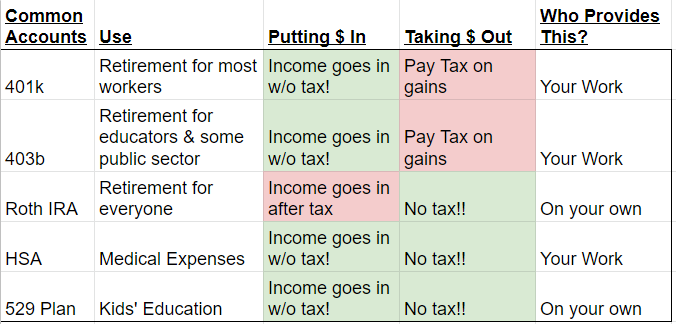
But what about my nephew who made $100,000 on ____ stock?
People make it big all the time on individual stocks. People lose their shirt all the time on individual stocks. That ones who make it big make the papers (or just tell everyone). The ones who lose everything don't.
Buying individual stocks can be fun, but should be treated a bit like going to the casino. Your odds are actually much better than the casino depending on the stock- but because you don't know the future - and stock prices are subject to all the emotions and irrationality of humans - they can fluctuate wildly and trying to predict this over time is futile.
The biggest benefit of a basic index fund is that your mind is now freed up from thinking about what to invest in, analyzing companies, etc. to focus on making lifestyle changes so you can contribute more (picking up biking for instance).
What about crypto?
I actually know someone who is up $100,000 in a month on a $10,000 crypto purchase. I’m not going to try and replicate it and neither should you.
For cryptocurrencies, take all of the irrationality and craziness and price fluctuations around an asset like stocks. Now take away the underlying asset that has real value and keep all the gambling and weird psychology (with a heavy dose of FOMO) around them. Boom. You've got cryptocurrency.
Remember that stocks have real inherent value - that Ford stock means you really own factories and intellectual property and everything that Ford owns. With crypto, there is no inherent value.
While blockchain is an intriguing technology that may or may not play a role in the 21st century, crypto currencies are something different altogether.
By definition they are not an asset. They don't produce anything over time - and they don't try to.
Unfortunately, they're not even currency. Until a crypto currency is a store of value, unit of account, and medium of exchange (the marks of "money") it is nothing more than a fascinating zero-sum experiment in human psychology, FOMO, and Greater Fools. Like with any speculative game, many will make money and any will lose money. Of course, feel free to play the game as much as you want with money you could comfortably lose.
Just don’t call it investing!
What about Warren Buffett?
I love Warren Buffett’s story. He is one of the few people who has beaten the market over his career and also he’s just an interesting person. Does that mean I should try and imitate him?

Probably not.
First off, he’s brilliant.
Second, he’s spent his entire life reading over financial documents - since he was about ten years old reading over financial statements. It’s his favorite hobby.
Third, how did he make his money? 99.99% of the time, the rules of the index funds are all you need to crush other funds. Every once in a great while, though, there are times when a very smart, cool-headed, cash-heavy independent thinker can outperform. Generally it’s in a crash.
Warren Buffett’s made a number of good investments over the years (though he’s been crushed by the index over the last fifteen years). But his best investing moments were stepping into what appeared to be a burning building and buying shares in that building for dirt cheap as people ran out screaming.
Fourth, the most underrated aspect of his success is his longevity (he’s invested in stocks from age 10 to 90, with 90+% of his net worth coming after age 70).
Fifth, here’s what he recommends to people (including his wife for after he dies) about making money in the stock market:
“I recommend the S&P 500 index fund”
Warren Buffett
I already know this stuff. Anything more advanced?
Sure. If you want extra credit (by that, I mean extra money), there are some advanced stuff you can learn about. Note that the advanced stuff isn’t about stock picking - it’s about lifestyle design and tax minimization:
Design Life to Maximize Contributions
If you’re able to bump up your savings rate beyond the 15% you can retire earlier- much earlier. In fact “years left working” is simply a function of one variable that’s in your control: your savings rate.
Ride a bike: After housing, transporation is the second biggest budget item for Americans. Luckily, you can reduce or eliminate it completely through biking.
The best resource on designing an efficient life is Mr. Money Mustache. It is truly the PhD in personal finance and what is possible for those who can live a bit more simply.
Avoid taxes altogether:
Roth Conversion Ladder: You can combine the power of your 401k and your Roth IRA to pay no tax going in AND no tax going out. It's called a "Roth Conversion Ladder" and while it's been in effect for decades, it's currently on the chopping block as a loophole Biden wants to close.
HSA: The Ultimate Retirement Account: Log your HSA expenses right away - but don't reimburse yourself until you need the money (preferably after retirement). Result: Tax free contributions, tax free growth, tax free withdrawals. Crazy.
Small-Cap Allocation: While the principle of index rules are more or less perfect, what’s not yet perfect is the weighting of the stocks in that index. VTI weights by market cap (the bigger the company, the more VTI has of that company). This means that most of what you buy in VTI is Apple, Amazon, and the other huge tech companies. By shifting the weighting towards smaller companies (but still using Vanguard index funds), there’s a good chance that you could outperform VTI in the long run.
Buy a Rental Property: If you’re willing to take on a bit of hassle, you can get returns that can crush Warren Buffett. And you might become a better person in the process (see link).
Retire in your 30s: That’s right. Most middle-class Americans can retire in their 30s if they're willing to put their extra money towards freedom instead of stuff. There’s a whole movement behind it.
What questions did you have around index funds or investing?

Investing: A Simple Zero-to-Hero Guide
"Over the years, I've often been asked for investment advice, and in the process of answering I've learned a good deal about human behavior. My regular recommendation has been a low-cost S&P 500 index fund,"
-Warren Buffett
There is a whole industry dedicated to increasing people’s height with pills. It's as scammy as you think it would be.
But I think back to when I played basketball. Back in ninth grade, basketball was my life. The problem? I was only 5'3". I needed to grow and I didn’t know much about what made people grow taller. Had I known about height pills, there’s a non-zero chance I might have fallen for them.
If I had bought ‘height pills’, I'd be out money. At worst, I would actually hinder my attempts to grow or even compromise my health.
So what do scammy placebo pills have to do with investing?
While most of us realize the stupidity of wasting money on something as pointless as height pills, this is exactly what most people do with their investing.
The difference is that with the pills we’ll be out a few hundred bucks. With our retirement accounts, it means losing out on hundreds of thousands of dollars over your lifetime.
In the investing world, these expensive placebos are called:
Mutual fund managers
Mutual fund fees
This usually costs investors far more than they understand. This happens because otherwise smart people lack a few simple concepts.
In this post, we’ll:
Take a whirlwind tour of what investing is
Recommend a single, practical action to give you maximum returns with almost no effort.
This action will allow you to retire with way more money in your pocket. If you’re young enough, this will most likely make you an automatic multimillionaire.
Investing Lessons from 20th Century
Back in the late 1800s, stocks became a thing. For the first time, average proletariat Joes could easily become capitalists, owning shares in massive, powerful companies for just a few dollars.
Stocks

A stock is part-ownership in a company. If you buy a share of Ford, you own a small sliver of their factories, the cars in stock, their intellectual property - and most importantly, you are entitled to your share of their profit, called a dividend.
Sounds pretty good, right? It is. That's why people are willing to pay for shares of Ford - about $18/share at the time of this writing.
As the company gets more productive and population grows (so there’s more people to sell to), the dividends get bigger and the price of the stock goes up.
The problem with individual stocks is that they were (and are) risky. A company can blow up 10x - or they can just blow up - to zero.
The question "What's a good stock to buy and at what price?" is hugely complex - and futile, as we'll see.
Mutual Funds
To solve the problem of concentrated risk, investment companies came up with a great idea in the 1920s. What if a bunch of investors got together to "mutually fund" the purchase of a wide number of stocks? It would allow ordinary people to get the gains of the stock market while spreading the risk over hundreds of companies instead of just one. The mutual fund was born.
The companies would then put an expert "fund manager" in charge of the picking, buying and selling the best stocks for the fund so Joe Schmoe investors could participate without having to know anything about investing and still profit.
Even though significant fees were involved to pay the fund manager and package the investment, the mutual fund was a huge step forward for the average investor.
Pointless Millionaires
Things progressed this way for a long time, with many people benefitting - particularly the fund managers. But in the middle of the century, some astute researchers started to notice something that was as unexpected as it was important.

Incredibly, they noticed that no fund or fund manager was regularly beating the market. For all the time and effort that smart, Harvard-educated Wall Street fund managers put in, they couldn’t pick stocks that were better than a simple average of the big companies in America (S&P 500).
Sure, on a given year, some beat the “index” - but most didn’t. And the ones that did beat the index quickly became the ones that didn’t. The ability of a fund to beat the simple average of the market was random.
In other words, all the billions of dollars in fees paid were a complete waste of money.
You read that right. Throwing darts at the "Stock" section of the Wall Street Journal will produce the same result over time as hotshot fund managers, even with the help of legions of analysts, corporate middlemen and brick and mortar locations on the most expensive island in the world (Manhattan).
This was a watershed moment - or it should have been.
These findings raised a question - THE question: "Why are we paying them so much then?"
The rational (and ethical) action for investment companies to take was to inform the public that their fees were pointless, shutter their doors, and turn off their personal trillion dollar firehoses that were making them the richest people to ever walk planet earth.
They promptly made the tough call to fire their fund managers and return the money back to the investors.

You didn’t really buy that, did you?
Wall Street firms changed nothing. They kept offering their funds, complete with hefty fees, and almost no one was the wiser. They’ve done it for decades and continue to this day.
Index Funds
Back in the seventies, one man decided to do the right thing. His name was Jack Bogle. In 1975, Bogle started a company called Vanguard. Bogle put into practice what we now know about the inability of even the smartest people to pick stocks.

Bogle took pride in not being a billionaire
Instead of hiring a hotshot manager with a team of expensive analysts, he replaced the traditional fund manager with a set of rules: "Own the 500 largest companies in America". Instead of paying someone to try and beat the market, he set out to be the market, providing the historical 8% returns without any of the expensive fees. When you include fees in the return, this new “passive” fund crushed other actively managed funds over time.
The rules made sure that its investors were invested in the most successful companies in the world without the downside risks of individual stocks. The best part was that the "rules" managing the fund didn't require a 200-foot yacht or a 4-story penthouse in the upper east-side.
His miniscule fee was just enough to pay his salary and run his office in Pennsylvania. The savings he gave back to the investor.
By doing this, he effectively passed over tremendous personal wealth as another hotshot fund manager, instead transferring trillions back to investors.
This is why Bogle has been called the greatest undercover philanthropist of all time and the index fund as sitting alongside “the invention of the wheel, the alphabet, Gutenberg printing press and wine and cheese.”
Crazy story, right? What does it mean for you?
Put it Into Practice
For most people (who don’t want the higher-work and higher-returns of rental properties), a Vanguard S&P index fund should be where you put your money. It turns out that all the findings of the last century can be applied with one simple action:
Buy as much VTI as you can in a tax-advantaged account and leave it there as long as you can.
VTI is Vanguard’s flagship total market index fund. You can go to vanguard and set up an account right now. Even better, set it to auto-invest 15% of your paycheck or so to ensure future millionaire status. Mix in some bonds (30-40%) close to retirement.
The arguments for this simple strategy have been borne out over much data, research and time. See:
Simple Path to Wealth (Book by JL Collins)
Little Common Sense Book on Investing (Short book by Jack Bogle himself)
How to Make Money in the Stock Market (Blog post by Mr. Money Mustache)
Just to name a few.
This advice shouldn’t be controversial, but there will always be people in the investing industry who still profit from ignorance. Don’t be surprised to find a few still selling the idea that they or someone they know can beat the market over time - though a few minutes of research will prove them wrong.
Conclusion
Investing has come a long way in the last century, both in our understanding and the products available to the average investor. Index funds have made it extremely easy for people to maximize stock market returns over time.
Way back in ninth grade, I stayed the course. Even while I stayed at 5’3” and people got taller around me, I drank my milk, ate a lot of food and most importantly I didn’t pay some guru promising “extra growth” for a hefty fee. The result? By junior year I had grown an entire foot. By simply taking what my genes gave me I grew more than I thought was possible. We need to do the same with our investing.
Buy index funds, forget the headlines, and let the magic of markets do the rest.

Got Questions?
If this is your first time learning about investing or index funds I’ve put together an FAQ to answer some of the questions that I had when I first heard about index funds. Read it here - cheers!
Comment
Subscribe
Share
What role do index funds play in your investing life?
Drop your thoughts below!
Who do you know who could use this post?

Parental Sacrifice in the Age of Opportunity

"What's better than a baby?"
Wait- what?
It was our first ultrasound. After a few minutes of poking around, our nurse gasped loudly (and my heart skipped a beat) as she asked us this strange, life-altering question.
So, what is better than a baby? The answer is two babies. We were having twins.
Seven short months later I found myself overwhelmed with joy - and just overwhelmed.
One sleepless night bled into another. Day and night blended together as synapses slowed to a halt. We were too tired to talk. Work happened in a fog.
Our marriage was reduced to indiscernible grunts as we passed in the hallway to tag in and out. With every day that passed, friendships, hobbies - my identity itself - withered on the vine. Slowly, the realization dawned that my life was not going to be the same. My life had not been “tweaked”. My life had been replaced. The old Brett was dead - killed by his own children.
Why do we do it to ourselves? Why does anyone choose to have kids?
It's a question - the question - the world is now asking. Once confined to places like Japan and Europe, declining birth rates are poised to take center stage as we near the middle of this century.
Rising (Opportunity) Costs
From the US to China, Mexico to India, we are quickly falling well below replacement value birth rates.

Excellent map created by reddit user Areat
Why is this?
While typical journalism focuses on economics, family policy, and climate change, the deeper reality that gets ignored is that children are puzzle pieces that simply don't fit into our age of expressive individualism.
[Expressive Individualism] suggests not only a desire to pursue one’s own path but also a yearning for fulfillment through the definition and articulation of one’s own identity. It is a drive both to be more like whatever you already are and also to live in society by fully asserting who you are. The capacity of individuals to define the terms of their own existence by defining their personal identities is increasingly equated with liberty and with the meaning of some of our basic rights, and it is given pride of place in our self-understanding.
-Yuval Levin, The Fractured Republic
Growing wealth coupled with the ever-growing power of the internet has opened up exponentially more opportunity than at any point in human history. Middle class workers can afford to travel (and live!) anywhere, date anyone, find any job. We have entered a new era in human opportunity.
The stairway up Maslow's hierarchy of needs has never been so widely available, accessible, and attractive. As a result, the opportunity costs of kids have never been so high.
Expressive Individualism + Kids : Oil + Water
Even for those who do become parents, a quick survey of popular online forums (e.g.) gives a glimpse into why many of us in the modern world have made this decision. Many parents attempt to fit their decision into the self-fulfillment ethic of our age.
Common Reasons include:
The Great Experience (this was mine :))
"Someone to take care of me when I'm older"
"Someone to share my life with"
"An anchor in an uncertain world"
In this view, there's an ROI to all this work and ultimately kids exist for our own sense of fulfillment.
As a dad of five years and a child of 30+ years, I’ll share one thing I have learned about parenting. Your kids’ debt to you will never be repaid. There are incredible rewards for those who become parents, but the sleepless nights, effort, the worry, the sacrifice will never be returned in this lifetime.
So the question remains - why do it? Why have kids?
Turns out, there are good answers - answers that would appear obvious to most people at most points in history. For us to understand them, though, we need to try and get outside the “life as personal fulfillment” fishbowl that we swim in everyday.
The Case for Kids
The Greatest Gift (theirs - not yours)
Why take on such a demanding lifelong project? What will get you through those dark nights of the soul filled with 3am wails and threenager defiance?
What won't help you is the hope for some future gift they may bestow on you decades from now.
Kids are an incredible gift - but when things get tough, the key is not to try and convince yourself of “what’s in it for you”. Trust me - it doesn’t work. Instead, the key is to remember the ultimate gift that you are giving them - the gift of life.

In having a child, you are buying a ticket. It’s not for you, but it’s a ticket for one soul to take in all that we call life. To witness a quiet sunset, to wonder at the night sky. To search for God, to fall in love. To discover, to laugh, to cry, and to learn. Maybe even to go through the joy and pain of having kids of their own.
Every experience you’ve ever known - the warmth of a mother's love, your first day at school, dancing at your friend’s wedding - is life - a life given as a gift because two people made a decision to bring you into the world and (if they did it right) to make hard sacrifices for you to give you a decent shot at it.
With every meal prepared, tantrum endured, and opportunity foregone, parents are buying their dearest little ones tickets to the greatest ride in the universe.
2. The World Needs Kids
All over the world, countries are confronting population stagnation and a fertility bust, a dizzying reversal unmatched in recorded history that will make first-birthday parties a rarer sight than funerals, and empty homes a common eyesore.
Maternity wards are already shutting down in Italy. Ghost cities are appearing in northeastern China. Universities in South Korea can’t find enough students, and in Germany, hundreds of thousands of properties have been razed, with the land turned into parks.
Like an avalanche, the demographic forces — pushing toward more deaths than births — seem to be expanding and accelerating. Though some countries continue to see their populations grow, especially in Africa, fertility rates are falling nearly everywhere else. Demographers now predict that by the latter half of the century or possibly earlier, the global population will enter a sustained decline for the first time.
-Long Population Slide Looms for World Population, Damien Cave, New York Times
Ever since God told Adam to "fill the earth and subdue it", humans have been doing just that - until... well, now.

Hugely influential book you’ve probably never heard of
While Paul Ehrlich’s Population Bomb of 1968 created seismic shifts in the way we think about children and birth rates, the world with few exceptions (see China) lumbered on. It is only now in the 21st century that we are finally taking Ehrlich's prescription for childbearing restraint.
The problem is that we might be overdosing on it.
After a population surge in the middle of the century, we will face a falling population for the first time in the history of civilization. While many would agree that less people would be a good thing, the effects of population decline will be as bizarre as they will be difficult - particularly if the change happens quickly.
"Imagine entire regions where everyone is 70 or older. Imagine governments laying out huge bonuses for immigrants and mothers with lots of children. Imagine a gig economy filled with grandparents and Super Bowl ads promoting procreation."
-Long Population Slide Looms for World Population, Damien Cave, New York Times
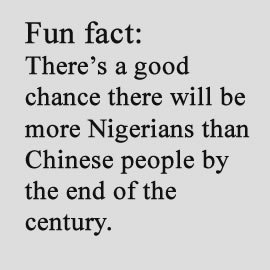
Ideas like retirement assume that other humans will be there to keep the world going while we bow out of the workforce. What does retirement look when workers, stock market gains, and real estate appreciation disappear?
"The biggest problem the world will face in twenty years is population collapse - not explosion - collapse."
So - we have kids to give the gift of life, we have kids for the world, and finally, we have kids for us - but not in the way you might think.
3. The Ultimate Character Builder
In 2014, I traveled to Peru and hiked the 3-day Inca trail to Macchu Picchu. It was incredible - and at times, tortuous. I still remember the second day, waking up to take on the 14,000 ft. ladder section called "Dead Woman Pass". I was sure it was going to be the dead Brett pass.

Peru, 2014 - Sweaty and shivering atop Dead Woman Pass
Cold sweat dripped down my face despite the 40 degree mountain chill. I sucked the thin air like I was suffocating as I took on twenty feet at a time up this brutal trail. What had I gotten myself into so far from the comfort of my home?
I don't remember that trip because it was easy. I remember it because it was hard.
That's why we went. We dug deep, we leaned on each other, and in-spite because of the voluntary trouble and cost we took on, we walked away with a once-in-a-lifetime experience that would form us for the rest of our lives.
Parenting is hard. It is a powerful jackhammer to our self-centeredness, the ultimate pressure cooker of sacrificial love. Kids will test your will, your marriage, your very soul. But if you are willing to head out on the trail and see it through to the end, you will emerge a tougher, more compassionate, more humble, vastly wiser version of yourself than you could possibly imagine.
People don't climb Mount Everest because it's easy. We didn't go to the moon because it was easy. We do these things because they are hard.
Conclusion
Kids have always required sacrifice. Technological, economic, and philosophical changes in the last three decades have exacerbated the challenge by raising the opportunity costs of parenting to an unprecedented level.
Good answers to the question of “Why Have Kids” require us to get outside of our “What’s in it for me?” mentality.
The decision to have kids only makes sense when we ask questions like:
What’s in it for our kids?
What’s in it for our world?
What’s in it for our character?
Through parenting, we give life, we learn to love unconditionally, and through sacrifice we become the best version of ourselves.
True confession: I expected kids to be easy - or at least not that hard. But kids are not easy. They are incredible- and they are difficult.
That's exactly why we need them.
Comment
Do you have kids or plan on having kids? How did you think through this monster decision?
Drop your thoughts below.
Subscribe
Share
Who could benefit from this post?

The End of Digital Gullibility

When I was a freshman in college, Facebook was irresistible. I was one of the “lucky” new college students whose newfound freedom was laced with a new addition to university life: social media.
Facebook was addicting long before the smartphone and the mini-feed. Sure, we wanted to figure out who the cute girl in our Econ class was, but more than that we wanted to catalog our friends, communicate with them, and keep an eye on what everyone was up to back home. I crafted my profile and let facebook beome a significant part of my life. I was digitally gullible. We all were.
What I didn’t know that I was one of the first lab rats in one of the most seismic social trials in human history.
We Know Better- Right?
Now we know better. If we were too busy scrolling to read The Shallows or Digital Minimalism, we at least harnessed our Netflix addiction to watch The Social Dilemma. We understand that the most powerful companies in the world are hiring attention engineers and using their billions of dollars with one goal- to addict us.
We now know social media is hacking our brain, stealing our time and our happiness, eroding our attention span, and tearing at the social fabric. We now understand that we are not the user- we are the product that social media giants are selling to advertisers.
So why in 2021 are we still spending over three and a half hours on social media per day?
Why are my pre-kindergarten children being issued their first Ipad as I write this? Why do I still have friends buying Apple watches and tablets without a clear use case for them? Why do we spend our entire night- from dinner to bedtime- hypnotized by the glow of our digital drug?
Maybe it's no big deal.
What’s at Stake

Wrong. Just weeks ago, The Wall Street Journal accessed an internal study that Facebook conducted. The stats that came from it aren’t the most damning- they’re just the latest. Here's some gems:
32% of teen girls said that when they felt bad about their bodies, Instagram made them feel worse.
6% of American users who reported suicidal thoughts traced those desires to Instagram. For British users, it was 13%.
+178%: Suicide deaths for children ages 10 to 14 nearly tripled from 2007 to 2017, when social media saw mass adoption.
Instagram is facebook’s most harmful, yet most profitable app- and, yes, they are coming for our kids.
21st Century Cigarettes
Social media is the cigarette of the 21st century. Today we take for granted that smoking cigarettes is both terribly addicting and terrible for your health. We forget that it took us the better part of half a century to figure that out. For decades, we gave them to our soldiers and smoked them around our kids. Even our doctors prescribed them. Cigarettes were everywhere even though they were slowly killing us.

This naive stage is where we are with social media. We are just beginning to understand the power and the peril of social media- particularly to young people, particularly to teenage girls.
One day we’ll see instagram and twitter for the cigarettes that they are and our habits (and our laws) will reflect that. But what do we in the meantime?
The Solution

If the "cool kids"- first the Marlboro man and now the IG influencer- keep getting us into trouble, then the solution to this epidemic lies with a group who has never been afraid to be uncool- the Amish.
We idealize the Amish in ways I assume are unhealthy, but it’s worth saying they aren’t actually against all modern technology. When a new technology comes into society, they evaluate it from the sidelines. They watch us like scientists watch lab rats with a new drug. Does it make us healthier? Or sick? Is it a net positive or no? They let us volunteer for the human trial. Then they have a community-wide conversation.
We’re still testing [the technology of the last 15 years] out as a species. And the early results are terrifying.
John Mark Comer, Ruthless Elimination of Hurry, p.42-43
“The Amish, it turns out, do something that’s both shockingly radical and simple in our age of impulsive and complicated consumerism: they start with the things they value most, then work backward to ask whether a given new technology performs more harm than good with respect to these values.”
Cal Newport, Digital Minimalism

The Amish like technology just as much as anyone else- but they simply have a conscious process for adopting and using new technologies as they come out. We must do the same.
Whether you take a digital detox, batch your social media to 1x/week, put a blocker on your phone, or completely dismantle your mini-feed like I did is secondary.
The primary step is to simply wake up- to start being intentional. We know that social media companies are being extremely intentional with us.
I'm for the intentional use of social media when we've consciously decided how we will use the product. But we must exert effort to keep the product from using us.
Conclusion
The 20th century saw the rise and fall of the cigarette. We went from celebratory acceptance to addiction. Eventually we realized how cancerous they wereand our behaviors and laws soon followed.
In the 21st century we must again let our intuition and the early science guide the way. This time around, it's not our lungs at risk- it's our minds, hearts- our very souls. For ourselves and those we love- we must end the age of digital gullibility.
Comment
What’s the role of social media in your life? Is there anything you need to change?
Drop a thought below!
Subscribe
Share
Who could benefit from this post?